Building an artificial intelligence agent is a highly rewarding technical process. You write the code, test your logic, and see your tool working perfectly on your local computer. But when you decide to share that tool with the public and earn money for your work, the process becomes much more difficult.
To sell access to an AI tool today, developers usually have to build an entire software platform from scratch. You have to set up user accounts, configure database storage, design a frontend website, and integrate payment systems. This requires months of extra work. It takes your attention away from building and improving your actual software.
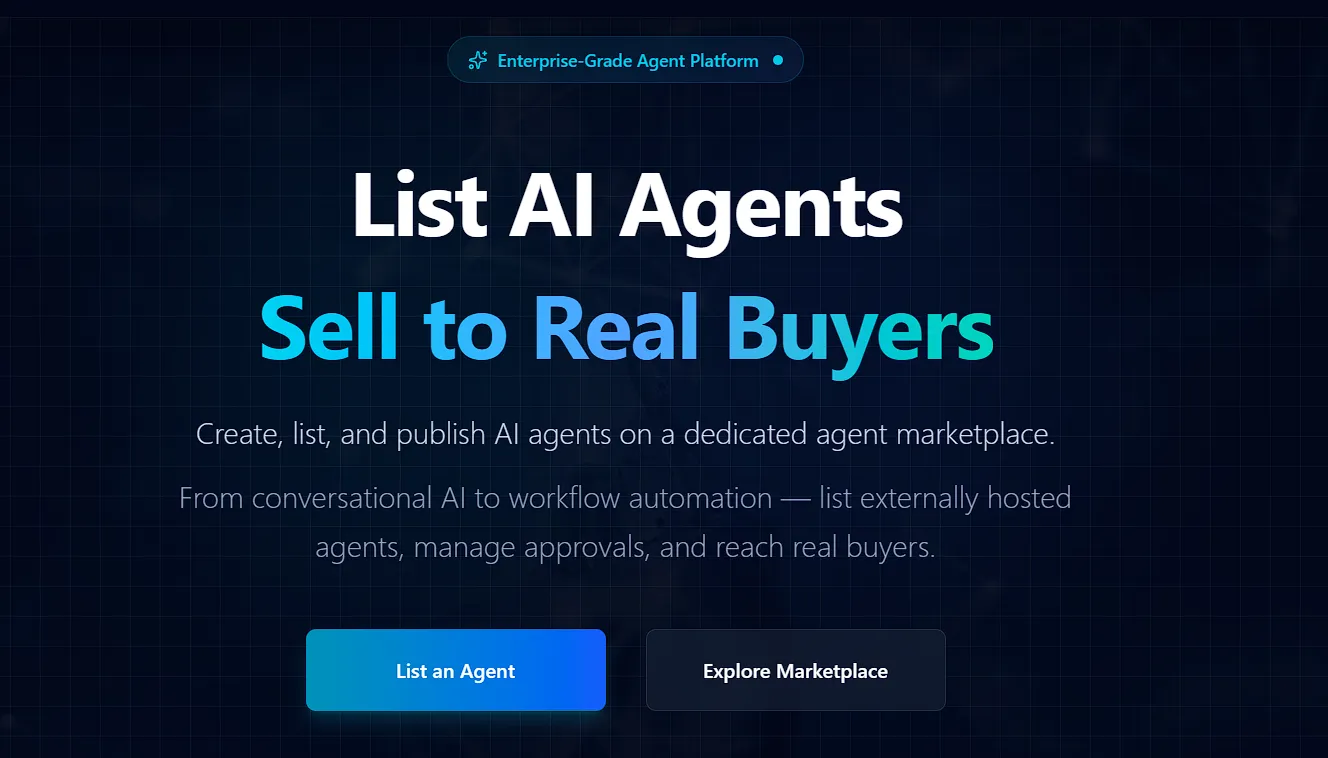
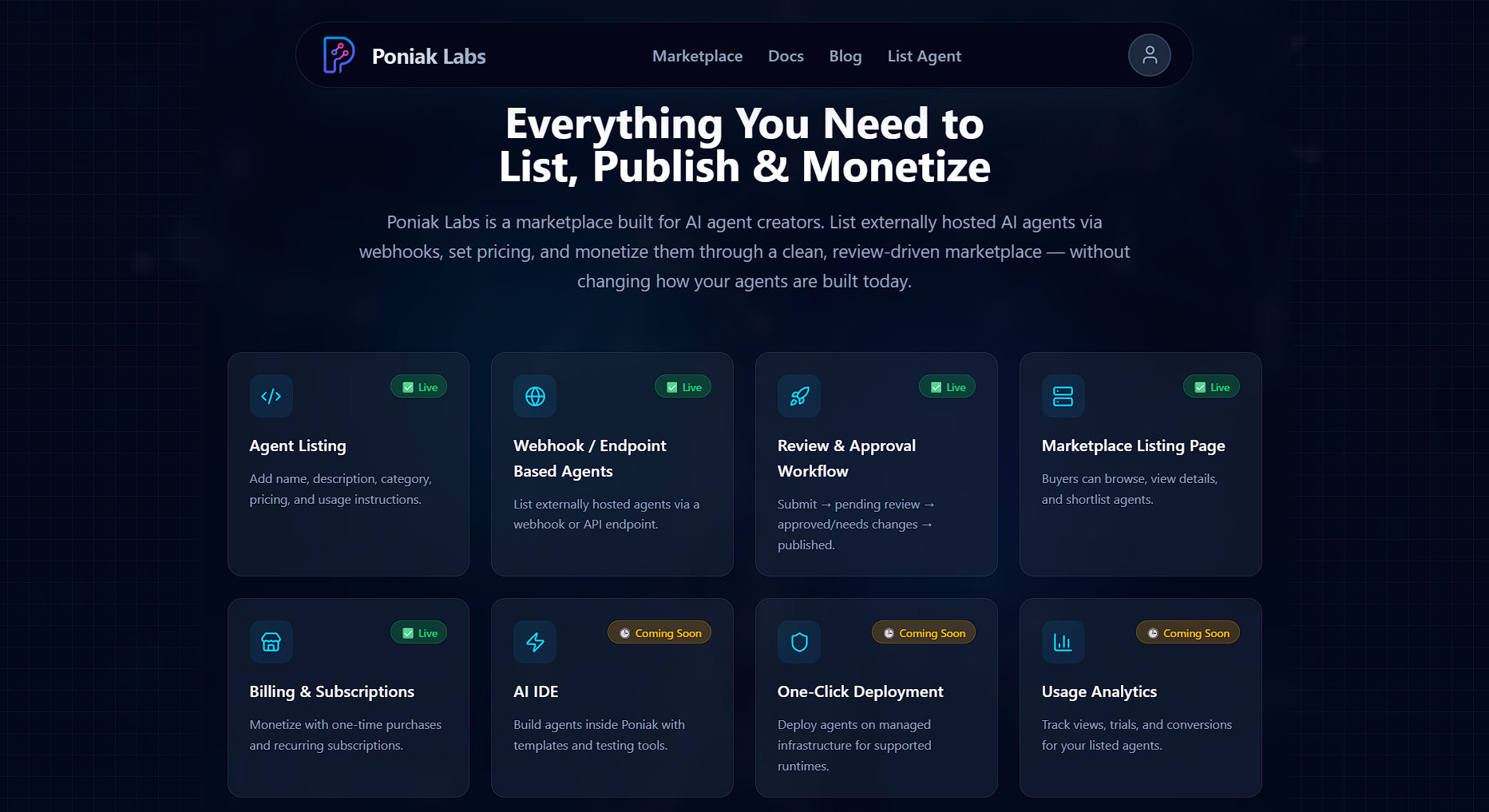
Poniak Labs is built to solve this exact problem. It is a dedicated marketplace platform for AI creators. It allows you to list, publish, and monetize your externally hosted AI agents. The platform handles the storefront, the billing system, and the customer discovery. This lets you focus entirely on your code.
Here is a detailed look at how the platform works, the features it offers for both creators and buyers, and how you can use it to monetize your projects using a straightforward system.
Keeping Control of Your Own Infrastructure
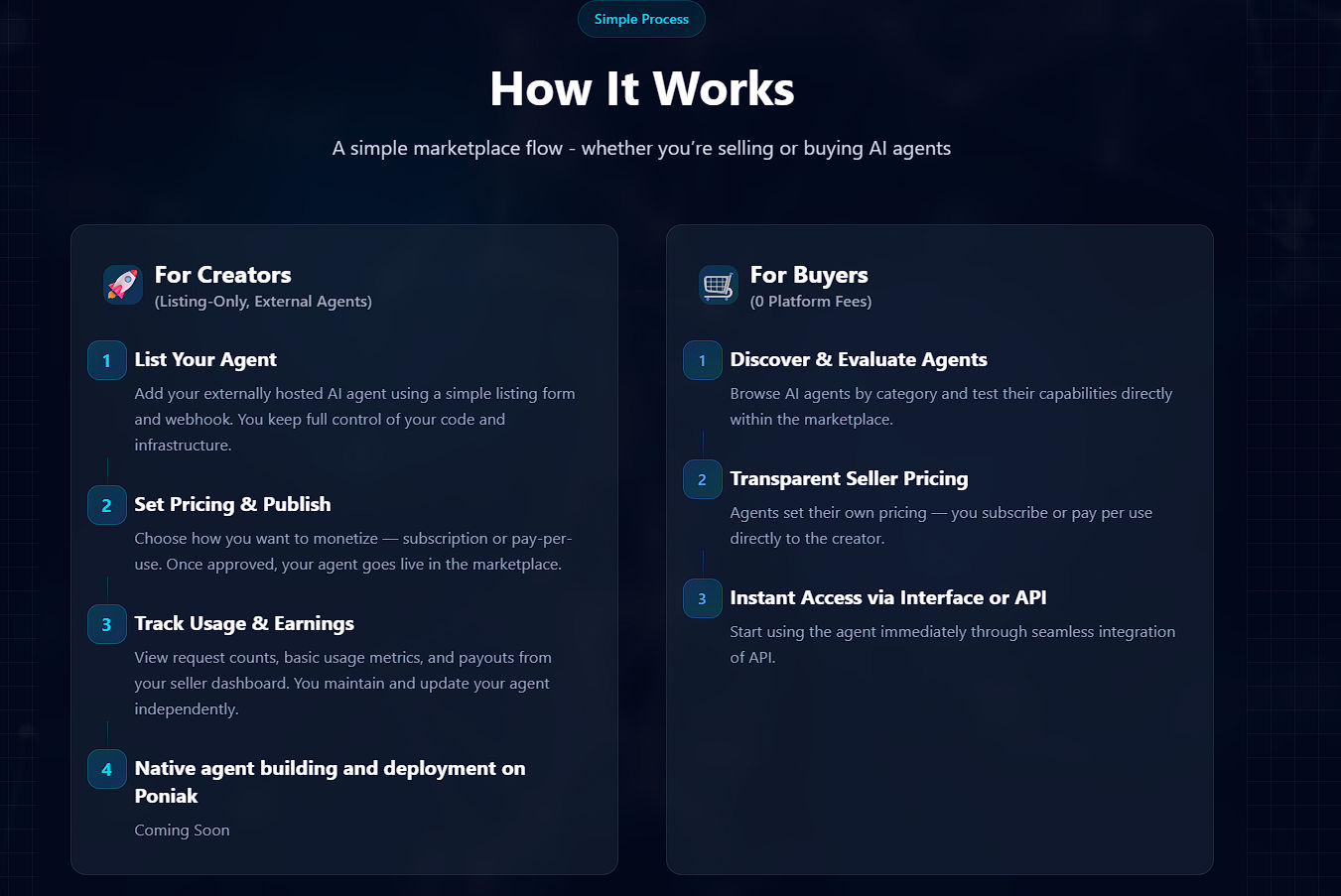
The most important thing to understand about Poniak Labs is that it currently operates on an external listing model. This means the platform does not host your code. You keep full control of your own infrastructure and your own intellectual property.
Whether you have built your backend using a specific JavaScript framework, a Python environment, a cloud function, or a custom server environment, you keep your setup exactly as it is right now. Poniak Labs simply acts as the bridge between your server and the paying customer. You connect your existing backend to the marketplace using a standard webhook or an API endpoint.
This approach is highly efficient because it requires almost zero changes to your existing technical stack. You do not have to migrate your databases, learn a new coding language, or rewrite your logic to fit a new platform's rules. You simply provide a secure URL to send data to, and the marketplace handles the rest of the work.
AI Categories and Market Opportunities
Artificial intelligence is a broad field, and developers are building tools for many different industries. To help buyers find exactly what they need quickly, the marketplace categorizes agents into specific, easy-to-understand use cases. If you are looking for ideas on what to build and list, here are the primary categories supported by the platform:
- Conversational AI: This category includes standard chatbots, internal company assistants, and specialized bots that can answer questions based on specific documents or industry knowledge.
- Workflow Automation: These are tools designed to trigger actions across different applications. Examples include systems that automate customer relationship tasks, route support tickets to the right department, or manage complex data pipelines.
- Data Analysis & Insights: These agents look at large amounts of data and extract meaning. You can sell tools that analyze spreadsheet files, build automated business dashboards, or summarize long financial reports in seconds.
- Content Generation: This is a popular category for agents focused on writing and creation. It includes automated blog writers, search engine optimization tools, social media caption generators, and video script writers.
- Email & Communication: Agents that handle messaging workflows. This includes tools for drafting emails, prioritizing busy inboxes, or automating sales outreach follow-ups.
- Customer Support: These agents are specifically trained to respond to support tickets, act as helpdesk assistants, and answer frequently asked questions for businesses so human workers do not have to.
- E-commerce & Sales: Revenue-facing agents that help online stores function better. This includes intelligent product recommendation bots, automated sales assistants, and lead qualification tools.
- Developer Tools: Agents built specifically for other software engineers. You can sell bots that review code for errors, help debug applications, or automate routine deployment tasks.
How to List and Sell Your AI Agent
Listing your tool on the marketplace is designed to be a clear process that takes only a few minutes. The platform provides a guided form to get your project live and ready for buyers. To keep the store high-quality, all agents go through a quick review before they are published. Here are the steps you follow:
1. Setting Up Your Public Profile
Before you list a product, you need to set up your public developer profile. This is managed in the Profile Settings area. You can upload a professional photo, set a clean username, and write a short description explaining your background and expertise. You can also link out to your external portfolios, such as your personal website, your code repositories, and your social media accounts. Building a complete profile helps establish trust with potential buyers who want to know who is behind the software they are purchasing.
2. Adding General Information
When creating a new listing, the first step is setting up the public face of your agent. You will provide a name and a detailed description. The description box supports standard markdown formatting, which means you can use bullet points, bold text, and headers to explain exactly what your tool does in a readable way. You will also select one of the categories mentioned above. Additionally, the platform allows you to upload a media gallery with images or short videos to visually demonstrate your tool working.
3. Configuring the Delivery Method
Poniak Labs supports three distinct listing formats for your tools: REST API/Webhook, Streamlit App, and GitHub/code repository listings.
If you are setting up a REST API/Webhook, this is where the technical connection happens. You will enter your Target API URL, which is the specific endpoint on your own server that the marketplace will communicate with when a buyer makes a request. To keep your server highly secure, you can set a Secret Authentication Header. This is a private key that ensures your server only accepts requests that genuinely come from the marketplace, preventing unauthorized users from bypassing the system.
For Streamlit App and GitHub/code repository listings, the setup is even simpler. Creators bypass the API settings and simply provide the relevant app URL or repository/code details instead.
4. Defining the Input Schema
Next, you must define the Input Schema using standard JSON format. This step is crucial because it tells the platform exactly what kind of data your agent needs from the user to function correctly. For example, if you built an image editing tool, your schema would specify that the user needs to upload a reference image and provide a text prompt. The marketplace uses this schema to automatically generate the correct input fields and forms for the buyer.
5. Setting Your Pricing Model
Once the technical connection is established, you decide exactly how you want to be paid. The platform offers a highly flexible pricing model. You can set a One-Time Fee if you want to sell lifetime access to the agent. Alternatively, you can set a Usage Cost measured in credits. The credit system allows you to charge buyers based on how much server processing power they actually consume, which is ideal for tools that require more computing resources to run.
Managing Your AI Business: The Dashboard
Once your profile is set up and your tools are live, you manage your business from the Dashboard Overview. The dashboard provides a clean, easy-to-read summary of your activity.
In the Seller Hub, you can manage your listed items, track your total sales, and view your overall earnings. You can also monitor basic usage metrics, such as how many requests your API is handling on a daily basis. This data helps you understand exactly how people are using your tool and when you might need to scale your server capacity to handle more traffic.
The dashboard also includes a Buyer Hub. If you decide to purchase tools from other creators on the marketplace, you can view your available credits, check your usage history, and manage your own API keys right next to your seller data. This creates a unified experience where you can easily switch between being a creator and a consumer without needing multiple accounts.
How It Works For Buyers
The platform is not just built to make life easier for creators; it is also designed to provide a smooth experience for businesses and individuals looking to buy AI tools.
Buyers see transparent pricing before purchase, including any applicable platform or service fees. When a buyer decides to top up their credits from the dashboard, they pay a 5% platform/service fee. For example, if a buyer tops up 100 credits worth $20, they pay a total of $21, where $1 covers the 5% fee.
Buyers can browse the marketplace, evaluate different tools by category, and read the detailed descriptions provided by the creators before making a decision. Once a buyer decides to purchase access, they get instant access. They do not have to wait for manual approvals or email exchanges. They can start using the tool immediately through a seamless integration provided by the marketplace.
Creator Pricing Plans
To keep the marketplace and billing systems running, creators choose from a set of simple plans. Poniak Labs is currently highly supportive of early adopters. Here is a breakdown of the current pricing plans available for creators:
- Creator Listing: This plan costs 12 USD per month. It allows you to list and monetize your external AI agents on the marketplace. It includes marketplace discovery, a public profile, standard usage analytics, and community support.
- The Founding Creator Program: Creators who list their agents on Poniak Labs on or before July 31st, 2026, are eligible for the Founding Creator Program. Under this exclusive offer, creators can use the platform completely free for the first 6 months and also keep 100% of their sales revenue during that entire period.
- AI IDE (Coming Soon): Developers can join a waitlist for this upcoming tier. It will allow creators to build, deploy, and scale native agents directly on Poniak's infrastructure using managed deployment and exclusive template libraries.
- Enterprise & Scale: This tier requires requesting a quote and is designed for agencies and teams looking to publish and control multiple agents. It offers unlimited agent listings under one profile, priority marketplace placement, advanced usage controls, and dedicated onboarding support.
The Founding Creator Program gives developers a risk-free window to list their agents, find their first customers, and generate real revenue while keeping every dollar they earn before the standard monthly platform fee begins.
Future Tools: Native Building
While the platform is currently focused on externally hosted agents, their documentation shows plans for an integrated AI IDE (Integrated Development Environment) coming soon.
This upcoming feature will allow creators to build native AI tools directly inside the platform's browser interface. Instead of hosting the code on your own server, you will be able to build, deploy, and scale production-grade tools using managed infrastructure provided directly by the platform. This will include access to exclusive template libraries and integrated testing environments.
Our Honest Opinion
Developing a functional software tool takes hard work, logic, and deep coding skill. Building the payment infrastructure, user authentication, and marketing storefront to sell that tool takes a completely different set of skills and a large amount of extra time that most developers simply do not have.
Poniak Labs serves as a highly useful link between independent developers and the businesses that need their tools. By allowing creators to maintain their own backend infrastructure while providing a clean, professional storefront for billing and discovery, the platform removes the heavy lifting of software sales.
Whether you have built a simple script to automate daily emails, a complex data analysis tool, or a highly specialized conversational assistant, this marketplace provides the exact framework you need. It allows you to securely connect your code, set your own price, and start generating revenue from your technical skills without the burden of building an entire software business from scratch. It is a highly recommended platform for any developer looking to turn their code into a sustainable business.


