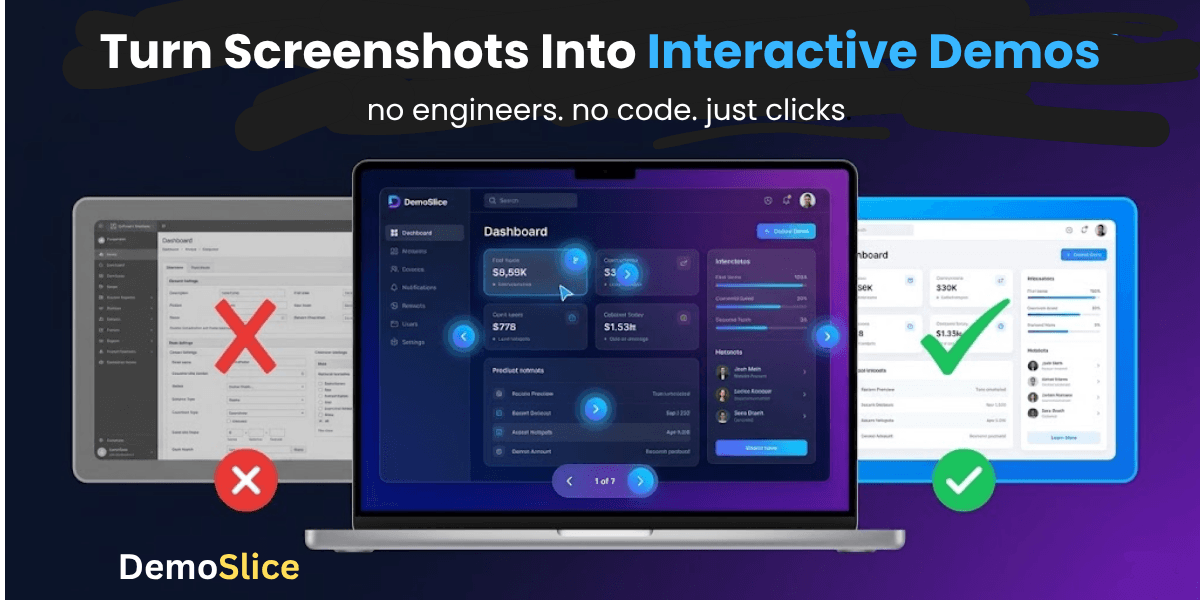
We've all seen a sales call go wrong , not because the product wasn't good, but because the demo just didn't work. Static slides. A Loom video that wouldn't load. An awkward silence that killed the whole momentum.
That's the exact problem DemoSlice was built to solve.
For years, software companies have dealt with the same gap. The product is solid, but the way it gets shown to people falls flat. Marketing waits on engineering. Sales reps share screenshots that don't really capture anything. And prospects are left guessing what the product actually feels like to use , so they don't convert.
There had to be a better way. DemoSlice is that way.
What Is DemoSlice?
DemoSlice is a platform that turns your product screenshots into interactive, clickable demos , the kind that actually feel like using the software, not just watching someone scroll through it.
The idea is simple. Upload your screenshots, arrange them in the order that tells your product's story, add hotspots and click targets, and you're done. In about five minutes, you have a shareable product tour that prospects can explore at their own pace , no engineers involved, no touching the production codebase, no waiting around.
Think of it as giving your prospects the wheel instead of making them sit in the passenger seat.
The Problem It Solves
The idea for DemoSlice didn't come from a whiteboard session. It came from watching a real sales team struggle in real time.
The founder describes sitting in on a call where a high-performing team was trying to walk a prospect through a complex UI flow , using static slides and a Loom video that kept glitching. The product itself was genuinely impressive. But none of that came through. The demo got in the way of the story.
That gap between what a product can actually do and how it ends up being shown , is what DemoSlice is built to close.
And that gap is more costly than most teams realize. Without the right tool, marketing and sales teams end up stuck in what the founder calls a "content bottleneck." They're constantly waiting on engineering to build and maintain demo environments that are expensive to run and break every time the product gets updated. Meanwhile, prospects never get to actually feel the product before deciding whether to buy it. They just have to take someone's word for it.
That's not a great way to sell software. And it's an even worse way to buy it.
How It Works
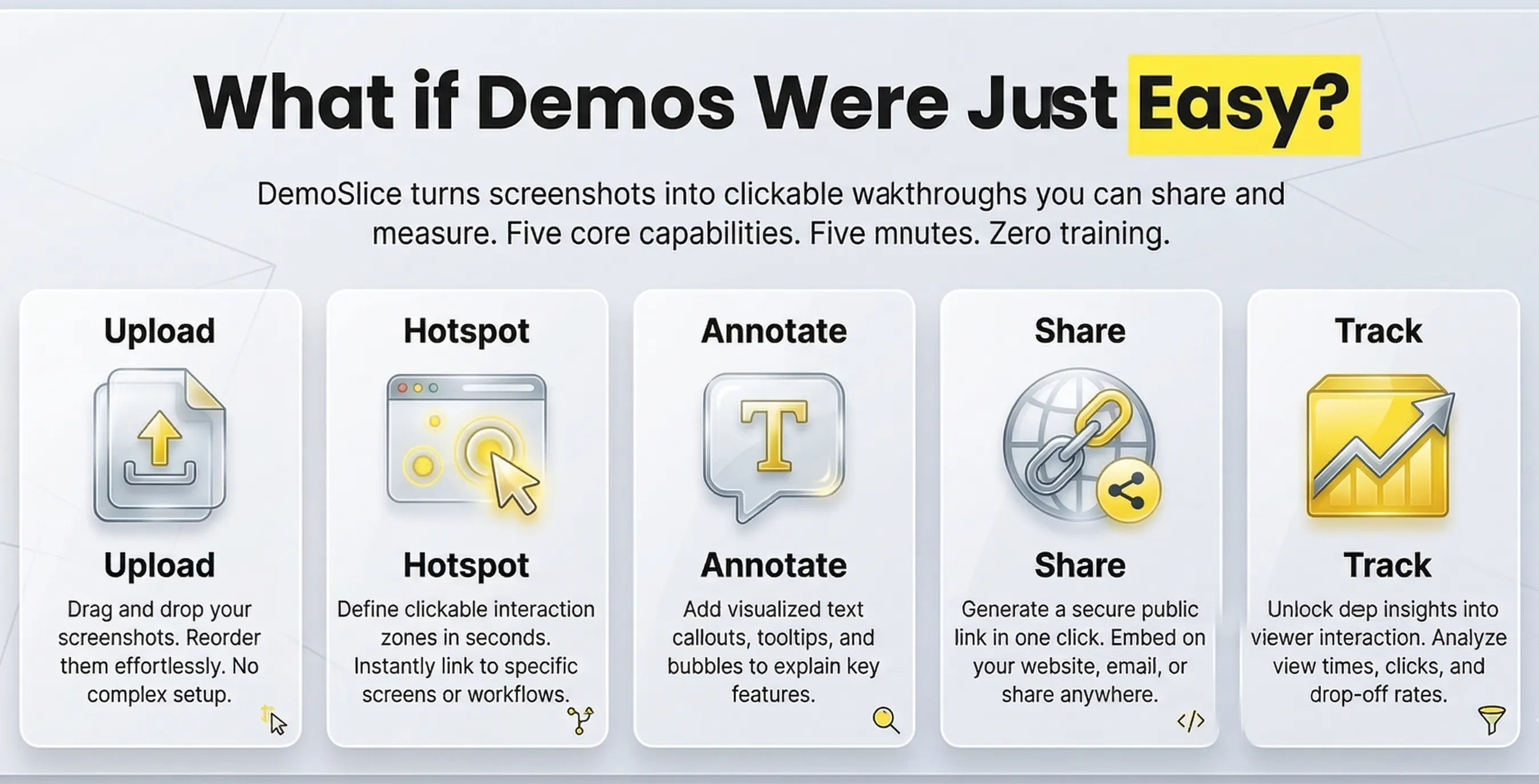
The workflow is deliberately simple:
Step 1: Upload your screenshots. No screen recording software, no browser extensions, no access to the live product required. Just the images you already have.
Step 2: Build the flow. Arrange your screenshots into a logical journey and add clickable hotspots and text bubble annotations that guide the prospect from one step to the next. Annotations let you drop in contextual guidance right where the viewer needs it, without any extra explanation required.
Step 3: Share the link. Send a single link to your prospect. They click through the product story at their own pace, on any device, without needing to log in or download anything.
Step 4: Track what happens. Every shared link is tracked. You can see recipient-level analytics, how long someone spent on each slide, which hotspots they clicked, and exactly where they dropped off. It turns a passive share into a real signal. The entire process takes under five minutes and requires no engineering involvement whatsoever.
Why This Matters for Sales and Marketing Teams
Interactive demos are no longer optional. Prospects today expect to try before they buy , and the data backs that up. People who can click through a product before purchasing are much more likely to convert than those who just watch a video or sit through a slide deck. This isn't a small difference. It's a pattern that shows up consistently across B2B sales.
So where does DemoSlice fit in?
Most of the big names in this space, Walnut, Navattic, and Storylane, are built for large enterprise teams with large budgets. Walnut alone starts at $20,000 to $50,000 per year. These tools work well, but they're simply not built for a small startup, a two-person marketing team, or a SaaS company that just needs a simple, shareable demo without a massive contract.
DemoSlice is built for everyone else.
It works across teams and industries, not just sales:
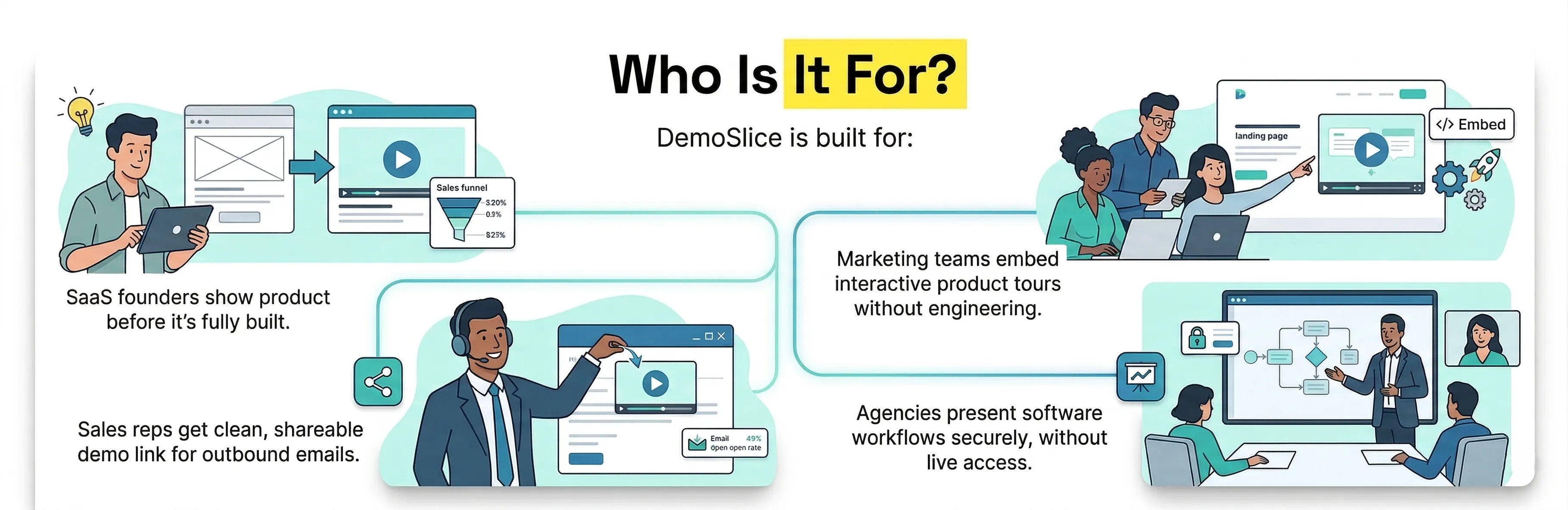
Sales Teams : send prospects a demo they can actually click through.
IT Teams : replace long Confluence docs with interactive step-by-step guides.
Customer Success : build your onboarding once and reuse it forever.
HR Teams : turn onboarding docs into walkthroughs new hires will actually follow.
Law Firms : walk clients through portals and processes without a call.
Real Estate : show clients how to use listing portals and sign documents with ease.
One tool. Dozens of use cases. And it starts at just $29/month.
Pricing
DemoSlice keeps its pricing simple and accessible. There is a free plan with no time limit, so any team can get started without a credit card or a commitment. Paid plans start at $29 per month, with no $20,000 per year contracts and no enterprise sales process required. For teams that have been priced out of dedicated demo platforms, this alone makes it worth exploring.
Conclusion
DemoSlice doesn't try to replace your live product or compete with full sandbox environments. It does something more focused and more immediately useful: it lets any team member, regardless of technical skill, turn what they already have (screenshots) into what converts (interactive experiences), fast. In a category dominated by expensive, complex tools built for enterprise sales teams, DemoSlice offers a refreshingly direct solution. There is a free plan to get started with no time limit. If your product story is currently living in a PDF attachment or a Loom video nobody watches, DemoSlice is worth a serious look.


