When a runner prepares for a long-distance event, such as a marathon or a trail ultramarathon, physical fitness is only one variable in a highly complex equation. An athlete can spend six months logging hundreds of training miles, running structured speed intervals, and tapering their physical effort, but if they fail to calculate their nutritional logistics, their race will likely fail to finish. On the day of a long-distance effort, runners must manage a precise intake of carbohydrates, fluids, and sodium while moving constantly.
If this fueling strategy is not planned correctly before the race begins, the runner faces a high probability of severe stomach distress, clinical dehydration, muscle cramping, or a total depletion of energy.
Nakamuve is a digital application built specifically to address and calculate this logistical requirement. Rather than tracking daily calories like a standard diet application or generating running workouts like a fitness watch, Nakamuve acts as a dedicated endurance fueling intelligence tool. It processes the specific distance of a race, the expected weather conditions, and the physical location of course aid stations to generate an executable, hourly nutritional timeline.
This guide details exactly how the Nakamuve platform operates, how it processes environmental variables, how its internal modules calculate race logistics, how it integrates with your existing fitness wearables, and how its pricing structure works for users.
1. The Problem with Standard Fueling Guesses
To understand the utility of Nakamuve, it is necessary to examine why standard, generic fueling strategies often fail during endurance events. Many athletes build their race strategies using basic advice found online, which rarely accounts for the specific physics and environmental realities of a real-world race course.
Nakamuve is engineered to identify these exact failure points before the runner begins the event:
- Gut Tolerance Limits: A standard nutrition article might instruct a runner to consume 90 grams of carbohydrates per hour. While mathematically sound for energy expenditure, attempting to digest that volume of heavy sugar during hour four of a race in high humidity frequently causes severe gastrointestinal (GI) distress. The human digestive system has strict absorption limits under physical stress.
- Unreliable Aid Station Spacing: Runners frequently assume that event organizers will place water stations at uniform five-kilometer intervals. In reality, trail races regularly feature eight to twelve-kilometer gaps between water sources across highly exposed terrain, leaving an unprepared runner without hydration support.
- Insufficient Carry Capacity: A runner may wear a standard hydration vest that holds exactly one liter of fluid. However, if their projected fluid requirement across an exposed, high-temperature mountain section is over seven liters, that one-liter vest becomes a critical and mathematically impossible limitation.
- Inadequate Sodium Strategy: A generic recommendation of 500mg of sodium per hour will fail if the runner's personal sweat rate exceeds 1.1 liters per hour in 29°C conditions.
By replacing generalized guesses with concrete data inputs, Nakamuve highlights exactly where a fueling plan is likely to break, allowing the runner to adjust their logistics in advance.
2. The Six-Step Planning Workflow
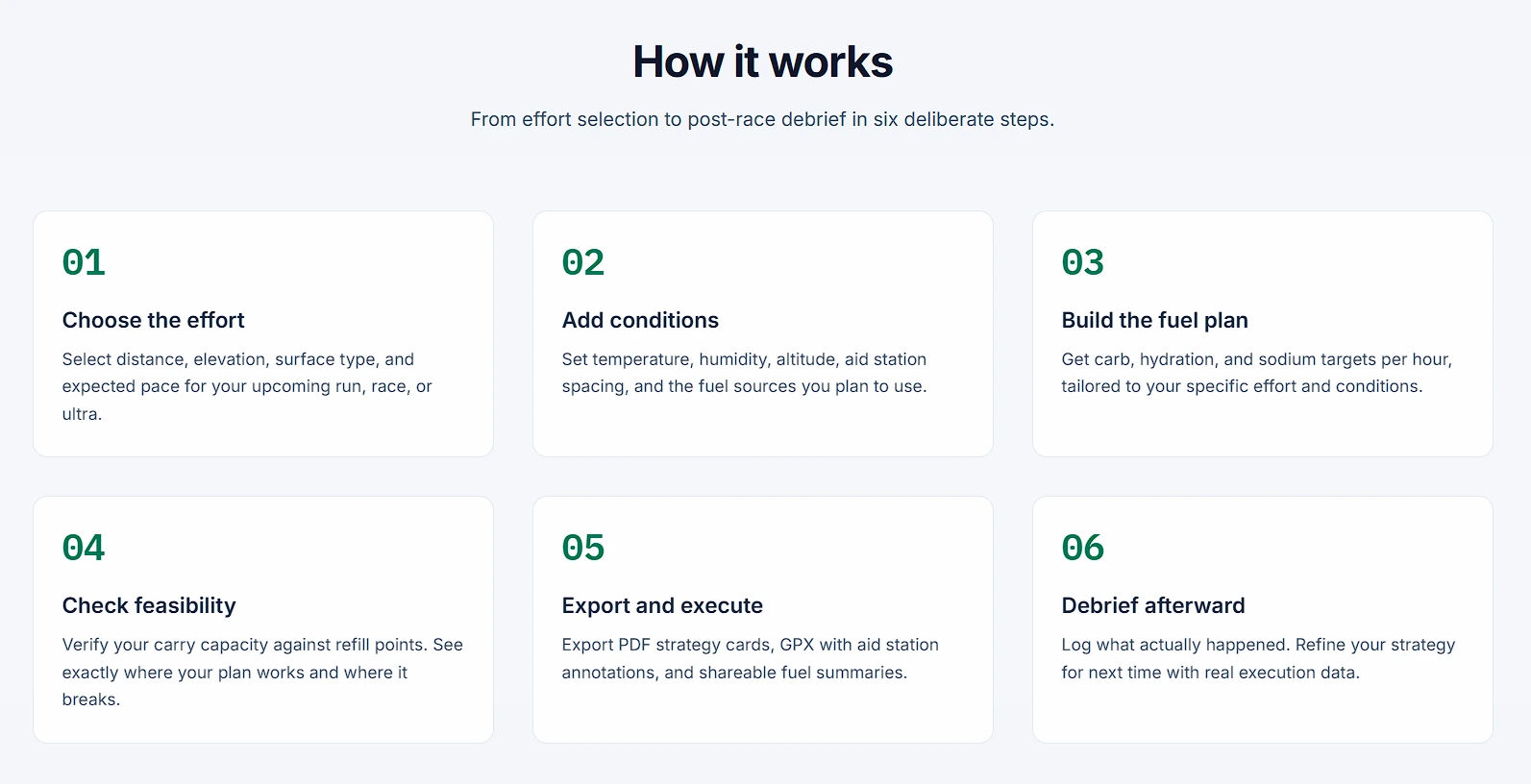
The platform is built to translate complex biological metrics and environmental data into a readable, executable strategy. To prevent the user from being overwhelmed by the calculations, Nakamuve structures the process into a clear six-step workflow.
Step 1: Choose the Effort The planning sequence begins with the core details of the upcoming run. The user inputs the total distance, the expected elevation gain, the surface type (such as paved roads versus technical trails), and their estimated pacing. This establishes the baseline "time on feet," which is necessary for calculating total required fuel.
Step 2: Add Conditions Environmental context significantly alters human digestion and sweat rates. In this step, the user inputs the expected temperature, humidity levels, altitude, and the physical layout of the course's aid stations. They also specify the fuel sources they intend to carry, such as commercial gels, drink mixes, or solid foods.
Step 3: Build the Fuel Plan Using the input data, the intelligence system calculates exact hourly targets. The platform outputs specific goals for carbohydrate intake per hour, fluid volume per hour, and sodium intake per hour, tailored directly to the environmental conditions on race day.
Step 4: Check Feasibility This phase tests the generated plan against physical constraints. It compares the runner's physical carrying capacity (for example, two 500ml soft flasks) against the distance between refill points. The system explicitly flags gaps, showing the runner exactly where their plan is viable and where they will run a fluid deficit.
Step 5: Export and Execute Once the logistics are finalized, the system generates exportable materials. Runners can download PDF strategy cards, export GPX map files annotated with aid station data, and print shareable summaries for their support crews.
Step 6: Debrief Afterward A race plan is a theoretical projection. Following the event, Nakamuve allows the runner to log their actual execution data. By comparing the intended strategy to the actual outcome, the runner can refine their gut-tolerance settings and improve their baseline metrics for their next race.
3. Operational Planning Modules
To ensure high accuracy, Nakamuve divides its data processing into four distinct operational modules. Each module is responsible for evaluating a specific variable of endurance race preparation.
Fuel Strategy Evaluation
This module focuses entirely on biological intake numbers. It assigns a letter grade (such as a B+) to the runner's plan and lists the exact hourly targets (e.g., 72g of carbohydrates, 610ml of fluid, 840mg of sodium). It serves as a safety monitor, generating automatic warnings if the numbers present a biological risk, such as alerting the user if their carbohydrate target approaches the known upper limits of human gut tolerance.
Carry and Refill Logistics
This system evaluates the physical weight and volume the runner must carry. It calculates the total fluid deficit across the entire race. For example, if an 11-hour trail ultra requires 7.4 liters of water total, but the runner can only carry 1 liter at a time, the module calculates a 6.4-liter deficit. It then determines exactly how many mandatory refill stops (e.g., 6 to 7 stops) the runner must execute to maintain adequate hydration, specifically flagging high hot-weather hydration burdens.
Aid Station and Refill Planning
This module maps the physical locations of aid stations against the runner's carry capacity, the elevation profile of the course, and the anticipated weather. It identifies unsupported gaps. If there is a 14-kilometer segment with a +3200m elevation gain and zero water sources, the system flags this as an unsupported danger zone. The runner is then prompted to increase their carrying capacity or adjust their strategy for that specific segment.
Fuel Inventory and Prep Cost
Endurance fueling requires significant financial preparation. This module takes the hourly fueling requirements and translates them into a physical inventory list. It calculates exactly how many commercial gels, DIY mixes, salt capsules, and solid items (like bananas or rice balls) are required. It provides an estimated total preparation cost (e.g., Rp 944.600), ensuring the runner purchases adequate supplies without overspending on unnecessary items.
4. Turning Data into an Hourly Timeline
Knowing that a race requires 72 grams of carbohydrates per hour is only practical if the runner knows precisely when to consume them. Managing nutrition while navigating technical terrain requires extreme simplicity, as physical exhaustion limits cognitive function and memory.
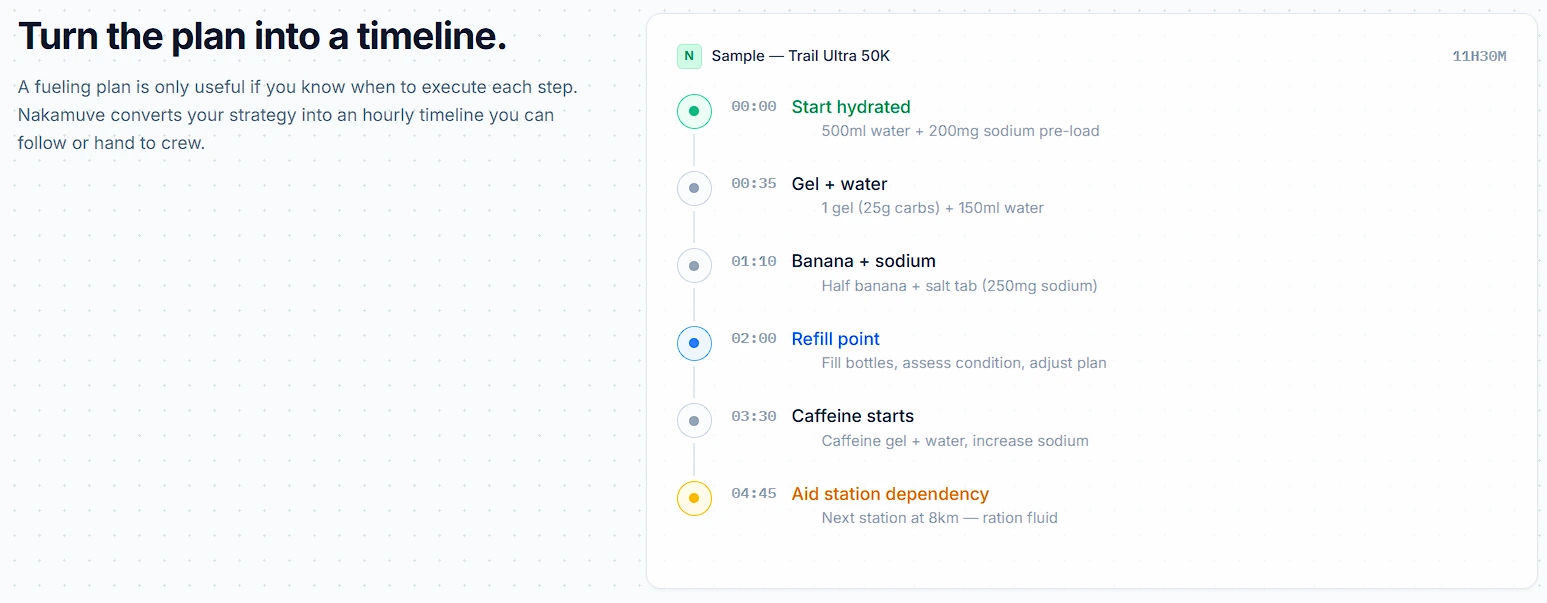
To resolve this, Nakamuve converts the complex logistical data into a simple, hourly timeline that a fatigued runner can easily follow. A sample timeline generated by the platform functions as follows:
- 00:00 (Start): Start hydrated with 500ml water and a 200mg sodium pre-load.
- 00:35: Consume 1 gel (25g carbs) plus 150ml water.
- 01:10: Eat half a banana plus one salt tablet (250mg sodium).
- 02:00: Arrive at refill point. Fill bottles, assess physical condition, adjust plan.
- 03:30: Begin caffeine intake with a caffeinated gel; increase sodium due to rising mid-day heat.
- 04:45: Note aid station dependency; ration fluid because the next station is 8km away.
This timeline is designed to be written on a piece of tape affixed to a water bottle or handed directly to a support crew, ensuring that the necessary nutrition is provided at the correct checkpoints without requiring the runner to perform mid-race mathematics.
5. What the Nakamuve Platform is Not
Understanding the strict limitations of a digital tool is necessary for assessing its utility. Nakamuve is a highly specialized logistical calculator, and it explicitly avoids integrating features common to standard, general-purpose fitness applications.
The platform defines its boundaries clearly:
- It is not a training plan generator. It does not prescribe daily mileage, weekly intervals, or recovery runs. It operates under the assumption that the user is managing their physical fitness independently.
- It is not a calorie diary. It is not built to track daily meals, scan barcodes, or assist with general lifestyle or dietary habits.
- It is not a weight-loss application. The platform focuses entirely on performance fueling and race-day execution, not body composition or caloric deficits.
- It is not a social feed. The application features no leaderboards, follower metrics, or social sharing capabilities for comparing finish times with other athletes.
- It is not an in-run logger. It functions as a pre-race planning tool and a post-race debriefing tool. It is not designed to run actively on a smartphone screen to track live GPS data during the event.
6. Device Integrations via Intervals.icu
While Nakamuve explicitly avoids acting as a daily workout tracker, it seamlessly connects to the hardware you already use. The platform features a direct, one-click integration with Intervals.icu. By linking your account, your activity data from major GPS wearables—including Garmin, Coros, Suunto, Amazfit, and Wahoo—flows into Nakamuve automatically.
This connection eliminates manual data entry. You can import scheduled workouts directly from your training calendar and pull in your exact athlete profile metrics. Most importantly, Nakamuve can push your finalized fueling plan back to your Intervals.icu calendar as event notes. This syncs your race-day nutritional instructions back to the ecosystem where your smartwatch can access them.
7. In-App Activity Selection and Tiers
Inside the application dashboard, Nakamuve requires users to select the specific type of activity they are planning. This ensures the algorithms apply the correct physiological and pacing adjustments to the final output. The platform categorizes these activities into one free tier and two premium options.
1. Simple Run (Free Tier) This option is designed for basic planning. It applies to paved surfaces and consistent pacing, making it highly suitable for beginner-friendly routes or standard, well-supported road races like a city half-marathon.
2. Structured Run Premium This selection is built for complex workout logistics. It supports structured workouts that include variable intensity intervals, tempo blocks, and repeated pacing changes, adjusting the fuel burn rate calculations accordingly.
3. Trail Run Premium This option is designed for off-road terrain. It applies to races involving massive elevation changes, technical footing, and GPX-based pacing where standard flat-road math cannot accurately predict time on feet.
8. Pricing Structure and Lifetime Access
A common issue with modern fitness software is the reliance on recurring monthly subscriptions for features that an athlete may only require a few times a year. Nakamuve approaches pricing with a highly straightforward, one-time payment system, eliminating the risk of hidden recurring fees.
- Free Tier ($0): The base application is available at no cost. It permits users to run a single-run fuel strategy evaluation for simple road runs. It provides basic carbohydrate, hydration, and sodium targets, making it a highly practical starting point for standard distance planning.
- Premium Upgrade (Rp 100,000 IDR / $10 USD): For serious preparation involving trails and structured workouts, Nakamuve offers a single, one-time payment for lifetime access.
This lifetime upgrade unlocks the entire suite of advanced logistical features, including:
- GPX Trail Uploads: The ability to upload digital course maps to enable elevation-adjusted pacing algorithms.
- Weather-Adaptive Recommendations: The intelligence system dynamically alters hydration and sodium targets based on the specific heat load and humidity of the selected race location.
- Feasibility Checks: Full access to the hydration carry capacity and refill feasibility testing modules.
- Structured Workouts: Access to interval and repeat-based fuel calculations.
- Full Exports: The ability to generate and download PDF strategy cards, GPX files with aid station annotations, and shareable race briefs for support crews.
Our Honest Opinion
Successfully finishing a long-distance endurance event requires managing complex biological and environmental variables simultaneously. For independent runners or athletes testing a new ultra-distance, relying on manual spreadsheets and generalized sweat rate guesses is an inefficient and often risky method of preparation. Nakamuve addresses this specific bottleneck by bypassing standard fitness tracking and automating the entire logistical fueling routine.
By utilizing structured intelligence to calculate gut tolerance, elevation changes, and weather adaptations, the platform removes the standard logistical guesswork of endurance running. Because it tests physical carry capacity against actual aid station locations and seamlessly integrates with major wearables like Garmin, Coros, and Suunto via Intervals.icu, it provides a systematic and reliable way to execute a race strategy. Furthermore, the transparent, one-time pricing model ensures athletes can prepare for complex trail races and structured workouts without managing recurring software subscriptions. For any runner seeking to translate raw course data and weather variables into a safe, executable nutritional timeline, Nakamuve operates as a highly specialized and practical utility.


