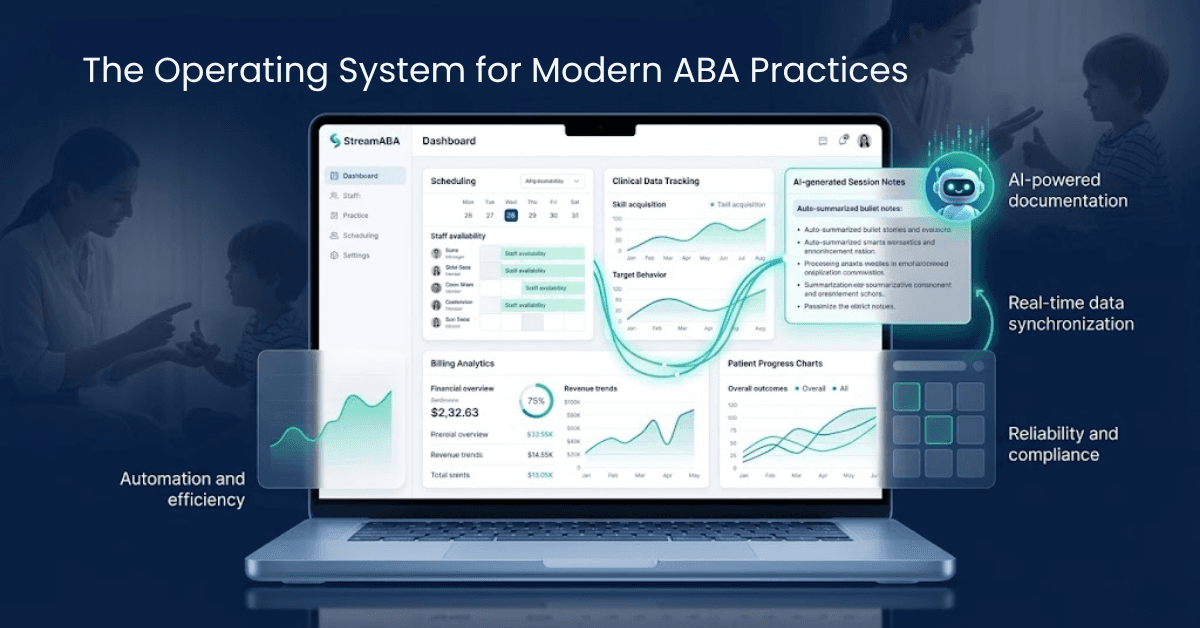
Applied Behavior Analysis (ABA) therapy is a science-based treatment approach primarily used to help children with autism develop communication, social, and behavioral skills. ABA practices involve a team of therapists, behavior analysts, and administrative staff, all working together across scheduling, clinical sessions, insurance billing, and family communication.
Managing all of this is where things break down.
Scheduling software doesn't talk to billing. Billing doesn't connect to clinical data. Insurance claims get rejected because a modifier was wrong. Session notes are written from generic templates that have nothing to do with what actually happened in today's session. Staff spend hours on admin work that should take minutes.
StreamABA was built to end all of that, one unified platform designed from the ground up specifically for how ABA therapy actually works.
What Is StreamABA?
StreamABA is an all-in-one practice management platform and EMR (Electronic Medical Records) system built exclusively for ABA therapy providers, BCBAs, RBTs, clinic owners, and multi-location ABA organizations. Currently in early access for top-tier practices, it positions itself as the operating system for high-growth ABA businesses.
The core promise is simple: one unified platform where scheduling, clinical data collection, billing, HR, and family communication all share the same database, so a session flows seamlessly from schedule to data collection to session note to insurance claim to payment, with no manual re-entry and no broken connections between disconnected systems.
The Problem It Solves
ABA practices today are stitched together from multiple legacy tools, CentralReach, Catalyst, and others, each handling a piece of the puzzle but none fully integrated. The result is a "content bottleneck" that costs practices in two ways: operationally, through hours of manual admin work, and financially, through claim denials that could have been prevented.
StreamABA's founder, who is also a Board Certified Behavior Analyst (BCBA) describes the core advantage this way: legacy systems were built as generic EMRs and later adapted for ABA, or assembled by acquiring and bolting together separate modules over time. StreamABA was architected from the ground up with a single data model across all domains. Scheduling, billing, clinical data, HR, and CRM share the same database and relationships, meaning the data collected during a session is the same data that generates the note, which is the same data that creates the claim.
That architectural difference matters more than it might sound.
Key Features
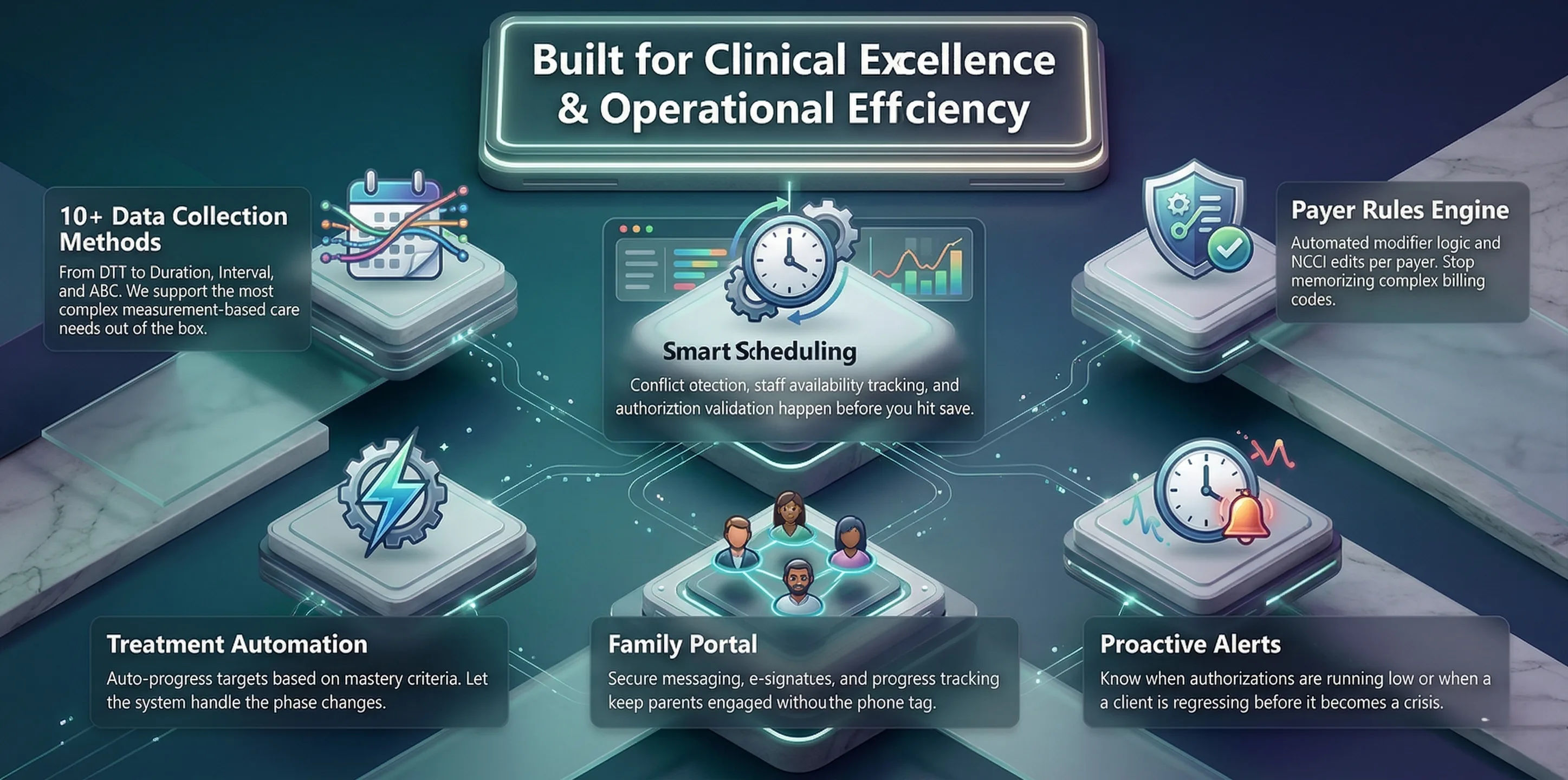
10+ Clinical Data Collection Methods
ABA is not one-size-fits-all, and StreamABA treats it that way. The platform supports:
- • Discrete Trial Training (DTT)
- • Frequency
- • Duration
- • Rate
- • Whole and Partial Interval
- • Momentary Time Sampling (MTS)
- • Task Analysis
- • ABC Data Collection
- • Scatterplot Analysis
- • Inter-observer Agreement (IOA)
- • and more all available out of the box, with offline sync for in-home field sessions.
Legacy systems were built as web-first desktop apps and have always struggled with field-based ABA work.
AI Clinical Documentation Grounded in Real Session Data
AI session note generation powered by real clinical data not templates.
One of StreamABA's most technically distinctive features is its AI session note generation. Unlike systems that bolt on AI as a separate product using generic templates, StreamABA's AI is wired directly into the clinical data pipeline.
When a clinician generates a note, the AI receives a SESSION CONTEXT block built from live database queries, actual trial accuracy percentages, frequency counts, duration data, goal names, and session metadata pulled directly from the data collection tables. If data doesn't exist, it is omitted, never fabricated.
Each AI call generates one specific field (such as "skills_narrative" or "behavior_outcome") with a field-specific prompt, keeping the scope narrow and the output factual.
Temperature is set at 0.3, favoring deterministic, data-grounded outputs over creative generation.
Payer Rules Engine, Catch Errors Before Claims Are Submitted
StreamABA's rules engine validates credentials, authorization units, and modifier requirements at scheduling time, not after a claim gets rejected. Automated NCCI edits, modifier logic, and authorization tracking with exhaustion projection mean practices stop working for free on uncovered sessions. The platform targets a 98.5% clean claim rate, with average days in AR down to 14.
Algorithmic Staff Matching
A multi-criteria scoring engine weighs availability, credentials, geography, clinical fit, continuity of care, workload balance, and even language and gender preferences to surface the best RBT match for each client instantly. Google Maps integration then optimizes daily field routes, flags backtracking, and estimates drive times with real traffic data.
Proactive Alerts Know Before Problems Become Crises
StreamABA acts as a 24/7 auditor for the practice. It automatically flags clinical regression when a client's performance drops significantly below baseline, predicts authorization exhaustion dates based on scheduling velocity, detects cancellation patterns, and alerts when staff credentials are approaching expiration all before they become billable or compliance problems.
Family Portal
A HIPAA-compliant family portal gives parents real-time visibility into their child's progress, e-signature capability for consents and treatment plans, secure messaging, and automated appointment reminders reducing the phone tag that consumes staff time.
HIPAA Compliance and AI Safety
For a platform handling Protected Health Information in a clinical context, HIPAA compliance and AI reliability are non-negotiable. StreamABA's approach on both fronts is notably rigorous.
On the infrastructure side, all AI calls route exclusively through AWS Bedrock an AWS HIPAA Eligible Service covered under the AWS Business Associate Agreement (BAA). PHI never leaves AWS infrastructure. No data is sent to OpenAI's direct API, Anthropic's direct API, or any provider without BAA coverage. Data is encrypted at rest across all storage layers RDS, S3, SQS, CloudWatch, and Parameter Store with KMS encryption and auto-rotating keys. Every note view, edit, sign, co-sign, amendment, export, and print is logged with user ID, IP address, user agent, and timestamp, with a dedicated HIPAA Note Access Audit page supporting per-client access reports.
On the clinical hallucination side, StreamABA uses a layered approach. Grounded prompts built from live data, explicit system instructions prohibiting fabrication, low temperature settings, and narrow per-field generation scope handle the technical side. On the human process side, AI output is always a draft never auto-saved. Notes stay in DRAFT status until the clinician signs with electronic signature and attestation. Signed notes are immutable; any post-signature changes require formal amendments with type and reason fields, with late amendments requiring supervisor approval. Mandatory co-signature workflows can be configured per payer requirements, with attestation language confirming medical necessity review.
Who Can Benefit from StreamABA?
StreamABA is purpose-built for:
• BCBA-owned clinics scaling from solo practice to multi-clinician operations
• Multi-location ABA organizations needing unified data across sites
• RBT-heavy field practices doing in-home sessions that require offline data collection
• Billing-focused practice managers trying to cut claim denials and reduce AR days
• Clinical directors who want automated mastery criteria, phase change tracking, and regression alerts without building it manually
Conclusion
StreamABA enters a market dominated by legacy tools that were never designed with ABA-specific workflows in mind. Built by a BCBA rather than adapted from generic healthcare EMR patterns, it encodes real clinical decision-making, mastery criteria engines, prompt fading, regression and plateau alerts, directly into the platform's core structure instead of leaving them as manual configurations.
This means practices are not just using software, but operating on a system that understands how ABA therapy actually functions in real-world clinical settings. From session data collection to billing and compliance, every layer is interconnected reducing errors, saving time, and improving overall care delivery.
For ABA practices that have outgrown spreadsheets and patchwork software stacks, StreamABA makes a technically credible and forward-looking case for what a ground-up, ABA-native platform should look like efficient, intelligent, and built to scale with growing clinical and operational demands.


