When people look at their digital to-do lists, the most common reason for leaving items unfinished is a lack of time. But as the core question of the You Have Time platform asks: Are you really as busy as you say you are? Professionals, parents, and creatives frequently claim that their schedules are too packed to handle one more responsibility. However, the reality of modern productivity is often more complicated. In many cases, people are not actually too busy; they are avoiding specific tasks due to anxiety, feeling overwhelmed, or simple procrastination. You know exactly what you've been avoiding, but starting often feels difficult.
You Have Time is a digital platform built specifically to address this behavioral challenge. Rather than acting as a standard checklist application, You Have Time functions as an anti-procrastination and scheduling tool. It connects directly to your existing digital calendar, identifies the hidden gaps in your day, and prompts you to see exactly how long you have been delaying specific tasks. Most importantly, it provides actionable steps to help you remove those tasks from your workload.
This guide breaks down how the You Have Time platform operates, the logic behind its design, how it integrates with your calendar, and how its current features work for users struggling with task avoidance.
1. Moving Beyond Standard Task Trackers
To understand the utility of You Have Time, it helps to examine why standard productivity applications often do not work well for users who struggle with procrastination. Most popular task management tools function like endless lists. You create a task, assign it a due date, and if you miss that date, the task simply turns red or rolls over to the next day. These systems rely heavily on a sense of urgency to motivate the user to get the job done.
You Have Time takes a different approach. The platform recognizes that standard applications do not solve the root cause of why a task is being ignored. If a user is avoiding a complex tax document or a difficult email because it causes anxiety, an overdue notification rarely provides the necessary motivation. In fact, it can sometimes increase task avoidance.
Instead of acting as a static list, this application operates as an objective view of your schedule. By analyzing your actual commitments, it proves to the user that the time to complete the task exists, effectively removing the excuse of having no time. It shifts the focus from feeling busy to actively figuring out how to get the avoided task done.
2. The Psychology of Avoidance Versus Busyness
The core concept of the platform is that people often struggle to estimate their own availability. When someone feels stressed, their brain perceives their schedule as completely full, even if there are multiple hours of unaccounted time available in their day.
The application addresses this by defining the difference between genuine busyness and psychological avoidance. Genuine busyness means every minute of the day is allocated to a non-negotiable activity, such as deep work, meetings, commuting, or childcare. Psychological avoidance occurs when a person fills their free time with low-effort distractions, such as scrolling through social media or reorganizing their desk, specifically to avoid the one task that is causing them stress.
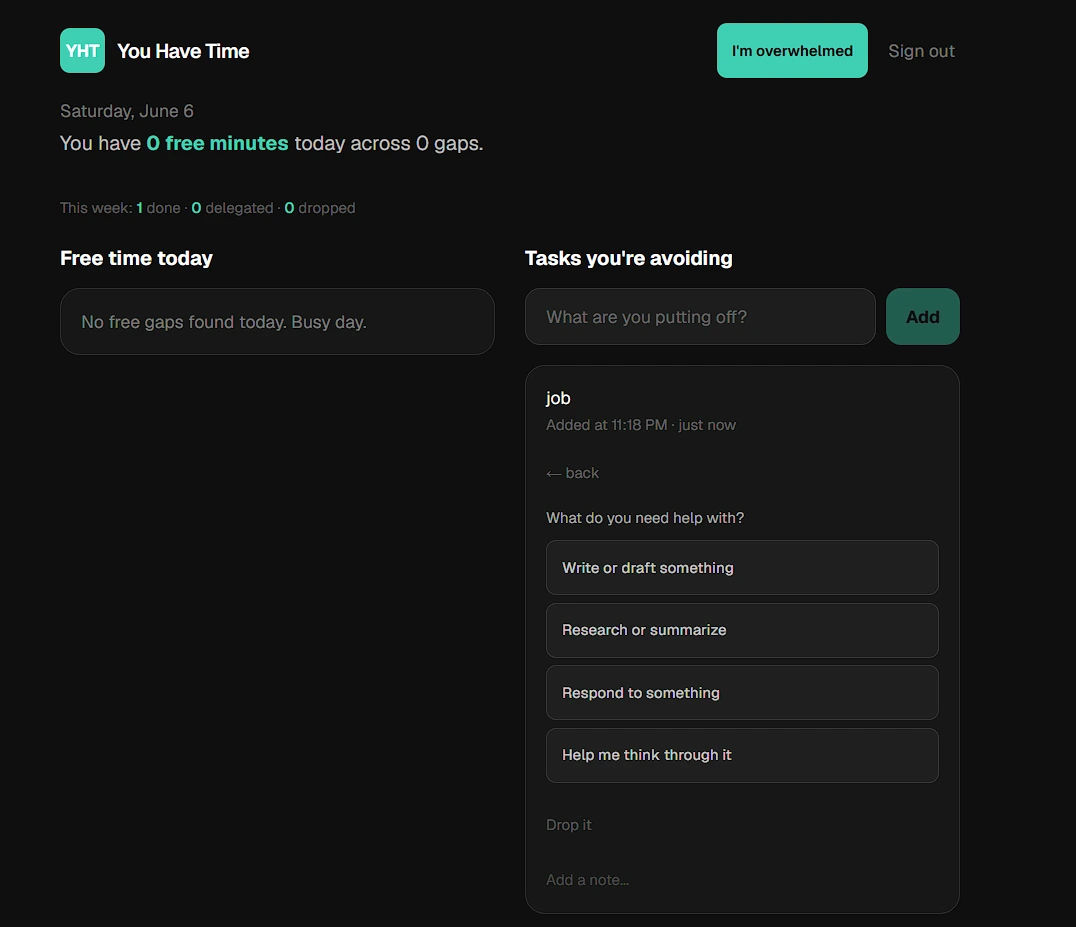
You Have Time is built to address this specific behavior. It tracks the exact lifespan of a task. If a user has been avoiding making a simple phone call for fourteen days, the platform highlights that duration. It prompts the user to acknowledge the reality of having to forgo a five-minute phone call for two entire weeks, helping break the cycle of passive delay.
3. The Three Core Pillars of the Platform
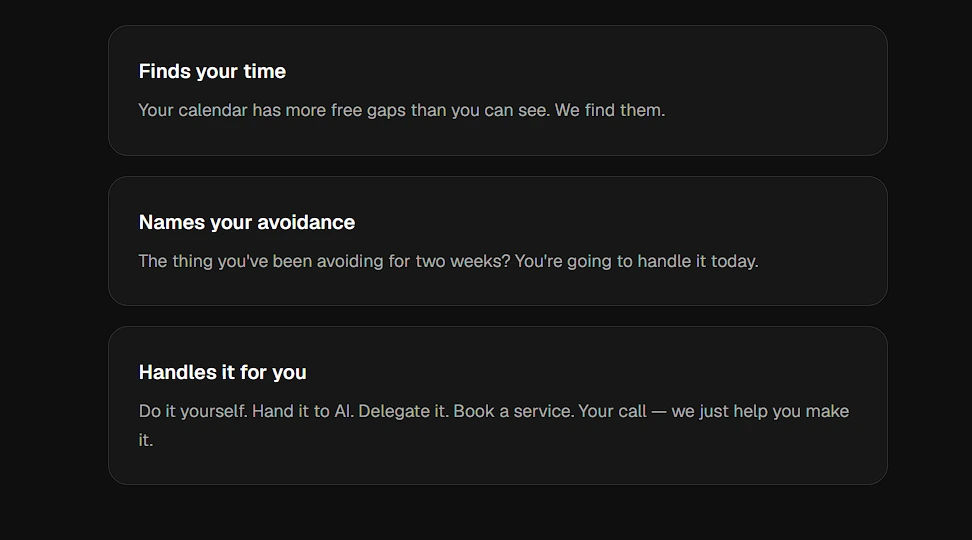
The entire user experience of the platform is built upon a clear, three-step process. The developer structured the platform around a simple mandate to: Do it. Delegate it. Own it.
Step 1: Finds your time Your calendar has more free gaps than you can see. The system acts as an auditor for your day, scanning for the whitespace that you might normally overlook. By mathematically proving that you have a free block of time between existing commitments, the application sets the stage for action.
Step 2: Names your avoidance The thing you've been avoiding for two weeks? You're going to handle it today. This is the application's most direct feature. It does not just show you what is due; it shows you exactly how long you have been putting it off. By bringing the ignored task to your attention during a verified block of free time, the system prompts you to make a decision about it.
Step 3: Handles it for you Once the time is found and the avoided task is identified, the platform requires you to take ownership. You must either complete the task yourself right then and there, hand it to AI, delegate it, or book a service. It is your call; the platform just helps you make it.
4. Deep Calendar Integration
A productivity application is most useful when it understands your actual daily routine. Forcing a user to manually type out their schedule into a new application introduces extra steps, which is unhelpful for someone already struggling with procrastination.
To solve this, You Have Time relies on a direct integration with your existing calendar ecosystem. By connecting directly to the schedule you already use, the platform can read your commitments in real time. It accounts for your blocked-out meetings, your scheduled lunches, and your transit times.
This integration allows the platform's free-time calculator to function accurately. It scans the empty spaces between your calendar events and aggregates them. If you have fifteen minutes free before a video call and forty-five minutes free after lunch, the system identifies those specific windows as actionable time slots. This prevents the user from feeling overwhelmed by a large workload, breaking the day down into manageable, bite-sized opportunities for productivity.
5. The Delegation Engine and AI Assistance
A notable feature of You Have Time is how it handles the tasks you simply do not want to do yourself. Recognizing that some tasks are difficult to start, the platform offers a built-in delegation engine. When confronted with an avoided task, the user has four distinct options:
- Do it yourself: Use the current block of free time to finally complete the task.
- Hand it to AI: If the task involves drafting a difficult email, writing a document, or summarizing research, the platform encourages the user to hand the work over to an AI assistant, reducing the friction of starting from a blank page.
- Delegate it: If the task requires human intervention but not necessarily your specific attention, the platform prompts you to assign it to a colleague, a virtual assistant, or a family member.
- Book a service: If the avoided task is a physical chore, like cleaning a house, fixing a leaky pipe, or running an errand, the platform suggests hiring a professional to handle it.
By presenting these four clear options, the application ensures that the task is resolved, even if the user is not the one physically doing the work.
6. No Streaks or Gamification
In the modern software industry, the standard method for maintaining user engagement is gamification. Applications use digital confetti, daily login streaks, badges, and point systems to encourage productivity.
You Have Time explicitly avoids this design philosophy. The platform operates on the belief that gamification can be counterproductive for chronic procrastinators. When a user breaks a long digital streak because they had one unproductive day, the resulting frustration often causes them to abandon the application entirely.
Instead of gamification, You Have Time uses a simple, distraction-free interface. There are no streaks to maintain, no high scores to beat, and no virtual rewards for checking off a box. The platform is designed to be guilt-free. It simply displays your schedule objectively and offers a practical way to manage your task list.
7. Built for Chronic Procrastinators and ADHD
While any busy professional can benefit from scheduling intelligence, the platform was engineered specifically to address chronic overwhelm. The application is highly beneficial for users dealing with heavy workloads, including individuals with ADHD and professionals managing complex daily responsibilities.
For individuals with ADHD, time management can be a significant hurdle. They often find it difficult to accurately estimate how long a task will take or how much time has passed, which can make traditional scheduling tools less effective. You Have Time addresses this by visually surfacing the exact lifespan of an avoided task and strictly defining the free gaps in a day.
Furthermore, individuals dealing with heavy workloads often experience guilt regarding what they are failing to accomplish. By providing clear off-ramps like AI delegation or service booking, the platform helps remove the stress associated with a growing to-do list. It turns a list of delayed tasks into a set of logistical steps that can be easily resolved through delegation.
8. Current Pricing Structure and Industry Reception
When evaluating a new digital tool, the barrier to entry is an important factor. Many productivity tools require upfront subscriptions or lock their most useful features behind a premium paywall immediately upon launch.
You Have Time addresses this by offering an accessible starting point, with paid tiers scheduled to launch on August 17th.
- Free Tier ($0): Currently available for new users, this plan allows you to manage up to 10 tasks, utilize 3 AI classifications per day, and connect your calendar to find free time gaps without needing a credit card.
- Personal Tier ($4/month billed annually, or $5/month): Set to launch on August 17th, this premium tier unlocks unlimited tasks and AI classifications. It also upgrades the calendar integration from reading your free time to actively scheduling tasks for you. It includes 24-hour task follow-ups and a weekly digest email. Users who sign up for the free tier today receive 50% off for life when the paid billing goes live.
- Pro & Team Tiers: The platform also has upcoming plans for power users ($9/month) and teams ($12/seat/month), which will include advanced features like full calendar audits, AI energy matching, and Slack integrations.
The software has gained notable early traction within the tech and startup communities. It has been featured on Product Hunt, Launch Llama, and PeerPush, and is currently trending on BuildHop. This industry validation highlights a growing interest in automated, practical scheduling solutions.
Our Honest Opinion
This product represents a useful shift in how the software industry approaches productivity and task management. You Have Time addresses the common issue of chronic task avoidance by replacing simple notifications with an automated, objective calendar audit. By finding the hidden gaps in your day and providing immediate delegation pathways for the tasks you are delaying, the platform offers a practical solution for managing your workload. Backed by strong community reception on platforms like Product Hunt, PeerPush, and BuildHop, it stands out as a helpful tool. For independent professionals and neurodivergent individuals looking for a reliable, data-driven strategy to secure their time, it is a highly recommended utility.


